Overview
qoala-mlir lowers a quantum-network program through three intermediate representations and then translates the result to the executable .iqoala format consumed by the Qoala runtime.
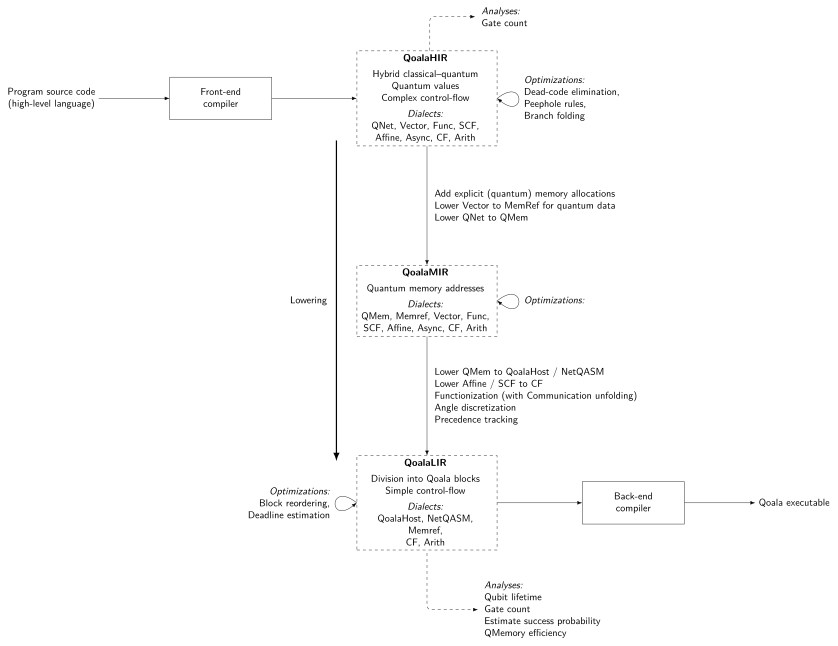
The pipeline
A program reaches qoala-mlir as a qnet (Qoala HIR) module emitted by the euqalyptus frontend. At the HIR level the program is expressed in SSA value-to-value form, which makes reasoning about gate cancellation, rotation merging, and quantum dead-code elimination convenient; passes such as qnet-peephole-optimizations and qnet-dead-code-elimination rewrite the program at this level before any lowering happens. The HIR-to-MIR conversion, run via lower-qoala-hir-to-mir, then replaces every !qnet.qubit SSA value with an explicit i32 qubit pointer in the qmem dialect, turning quantum operations into side-effecting calls on those pointers.
Once the program is in MIR, a small family of helper passes prepares it for the structural changes that turn it into a Qoala-block-shaped LIR. lower-float-rotations rewrites floating-point angles to the integer-pair form NetQASM accepts; unfold-comm-ops decomposes multi-value classical communication ops into single-value variants; functionize extracts contiguous groups of quantum operations into stand-alone NetQASM routines; and fold-constants cleans up the constants left behind. The MIR-to-LIR conversion, run via lower-qoala-mir-to-lir, then splits the single mixed function into a classical host body expressed in the qoalahost dialect, one or more quantum routines in the netqasm dialect, and module-scope remote-node declarations in qremote.
LIR is the level at which the runtime-facing structure of the program becomes visible and at which scheduling-oriented passes operate. qoalahost-add-block-precedences materializes the inter-block ordering edges the runtime relies on, qoalahost-reorder-blocks solves a MILP to shorten qubit lifetimes (and, optionally, to compute per-block deadlines), and once the module is finalized, qoala-translate --mlir-to-iqoala emits the textual .iqoala executable.

The three IRs at a glance
| IR | Dialect(s) | What it expresses |
|---|---|---|
| HIR | qnet |
Value-based quantum semantics. Qubits are SSA values of type !qnet.qubit. Passes here are concerned with algebraic equivalences over gates. |
| MIR | qmem |
Explicit quantum-memory model. Qubits are i32 pointers; ops are side-effecting. Convenient for layout, lifetime, and angle-discretization concerns. |
| LIR | qoalahost + netqasm + qremote |
Runtime-shaped form: a classical host body (qoalahost.main_func) calls quantum routines (netqasm.local_routine, netqasm.request_routine); remote nodes are referenced by symbol (qremote.remote). |
For the deeper version see The three IRs and the per-dialect entries in the Operations reference.
Tooling at a glance
The build produces two command-line tools and a Python bindings package. qoala-opt is the workhorse: it registers all standard MLIR passes together with the dialect-specific passes documented in the Passes reference, and exposes a small set of cost-model flags (--qoala-opt-single-gate-duration, --qoala-opt-link-duration, and so on) used by the analyses and by the MILP-based block reorderer. qoala-translate is much narrower in scope — it registers a single translation, --mlir-to-iqoala, that prints the .iqoala form of an LIR module. Alongside the two binaries, the build produces the Python bindings (qnet) under qnet.dialects.qnet; this is what euqalyptus imports to construct HIR programmatically.
Cross-references
The frontend that produces the input HIR is documented at euqalyptus. When you need to settle an invariant- or behavior question, prefer the Operations reference and the TableGen .td files under include/Dialect/ over the design paper — the paper describes design intent and may have drifted relative to the implementation.