From Python to Qoala HIR
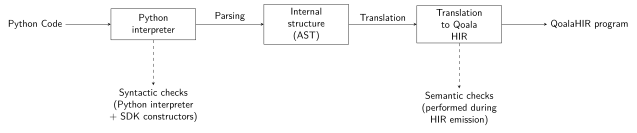
When you call program.compile(), the SDK turns your Python function into a QoalaHIR module in four conceptually distinct stages, all carried out inside the body of compile() defined in euqalyptus/__init__.py.
Stage 1: setup
compile() first acquires the global _compiler_lock. The recording protocol used in the next stage relies on a class-level slot, QoalaProgram._instance, that points to whatever program is currently being compiled, and that slot is what lets user-facing constructors like Remote("Alice") know which program to declare a remote on. The global lock keeps that single-instance invariant safe; the trade-off is that two QoalaProgram instances cannot be compiled concurrently from the same process — calls serialize. For a typical CI loop this is transparent; only a tool that wants parallel compilation would need to refactor that state.
Once the lock is held, compile() sets QoalaProgram._instance to self, resets the class-level _declared_remotes cache, and constructs a fresh CompilationContext that captures some compilation options, like compile_lazy and singular_comm_ops. It also clears the program's QoalaModule and adds a single function to it, named after the entry function — typically my_program for the decorator form or main for the class-based form. By the time stage 1 ends, the SDK is in recording mode.
Stage 2: recording
Now your Python function runs. From Python's perspective nothing unusual happens — the interpreter walks the body once, executes each line without executing the semantics of it, and returns whatever the function returned. The semantic-less execution is important since every SDK call along the way is intercepted by a constructor or context manager that records an AST node into the active function body instead of performing its nominal action immediately. This effectively helps building the AST without executing what the SDK user wants to run.
@QoalaProgram
def example():
    Remote("Alice")
    q = Entangle("Alice")
    m = q.measure()
    send_int("Alice", m)
When this body runs, Remote("Alice") reaches euqalyptus.operations.Remote.__new__, which either returns the existing DeclaredRemote for "Alice" or constructs a new one — so calling Remote("Alice") twice yields the same object. Entangle("Alice") is a factory function (defined in euqalyptus/types/quantum/qubit.py) that checks the remote is declared and produces an EntangledQubit, itself a QoalaEprs AST node. The subsequent q.measure() reaches Qubit.measure, which in turn calls QoalaEprs.measure, records a qnet.measure-shaped AST node into the function body, and returns a QoalaInteger AST. Finally, send_int("Alice", m) flows through the SendInts factory in euqalyptus/operations/communication.py (recall that send_int is an alias of the variadic SendInts — single-value scalar HIR sends are emitted only under compile(singular_comm_ops=True)), which wraps the AST node m and the remote name into a send op and pushes it into the current function body.
The pseudo-AST built up this way is structured exactly like the HIR will be: a QoalaModule contains QoalaFunctions; each QoalaFunction has a body that is an ordered list of QoalaOperations; and each QoalaOperation references QoalaExpression operands and produces QoalaRuntimeValues. You can inspect this state directly by passing compile_lazy=True to compile() — the AST is built but stage 3 is skipped, so what you get back is the recorded structure without any MLIR emission.
Stage 3: emission
If compile_lazy=False (the default), compile() calls module.generate_qoala_hir(). That walks the AST and emits the corresponding MLIR ops using the qnet Python builders shipped by qoala-mlir, so each AST node maps to a builder call in the qnet dialect:
from qnet.dialects import qnet
from qnet.ir import Module, Context, Location, InsertionPoint
Concretely, generate_qoala_hir() creates an MLIR Module inside a fresh Context, then emits a qnet.remote declaration for each previously recorded remote and a qnet.func wrapping each recorded function:
with Context() as ctx, Location.unknown():
    self._qir_module = Module.create()
    with InsertionPoint(self._qir_module.body):
        for r in self._remotes:
            qnet.remote(name=r.name)
        for fn in self._functions:
            self._emit_function(fn)
After this returns, the module's asm property pretty-prints the MLIR via _qir_module.operation.get_asm().
Stage 4: teardown
The final stage of compile() is bookkeeping. The remotes accumulated in _declared_remotes are copied onto module.remotes, the program's _is_compiled flag is flipped to True, the class-level QoalaProgram._instance is cleared, and the global lock is released. The call returns (return_value_from_user_function, the_module).
What branching interception looks like in practice
A with if_cond(m == 1) as (t, f): block in user code does not run real Python control flow over a quantum-network value. What it actually does is record a ConditionalBranching AST node and enter context-manager state that swaps the "current function body" pointer to a sub-list. Anything recorded inside the with body lands in that sub-list; exiting the context manager pops back to the parent body. The user-visible Python control flow is therefore a recording protocol — the actual branch lives in the recorded AST and shows up downstream as an scf.if in HIR.
This page does not document the branching ops in detail; for that, see the Branching reference (and, for a worked example, the Teleportation receiver).