Remotes
Remote nodes are referenced by name. Before any classical or entanglement op can target a remote, the program must declare its name with Remote(...).
Source: euqalyptus/operations/__init__.py.
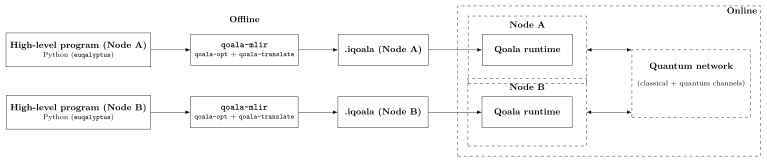
Simulating the online part
The "online" portion of the flow shown above — the actual execution of the compiled .iqoala programs against a Qoala runtime, including entanglement generation and inter-node messaging — can be simulated end-to-end with qoala-sim.
Remote("Name")
from euqalyptus.operations import Remote

bob = Remote("Bob")
Remote(name) records a DeclaredRemote in the active program's module. The first time a given name appears, a qnet.remote symbol is emitted at module scope. Subsequent calls with the same name return the same DeclaredRemote object — i.e. it's idempotent within a compile().
You typically do this once at the top of your program for each remote node it talks to:
@QoalaProgram
def alice_to_bob():
    Remote("Bob")
    Remote("Charlie")          # talks to two remote nodes
    ...
Using a declared remote
Communication and entanglement operations accept either a Remote(...) value or a plain string:
bob = Remote("Bob")
q1 = Entangle("Bob")           # via name
q2 = Entangle(bob)             # via the Remote object — equivalent
send_int(bob, m)               # via the Remote object
send_int("Bob", m)             # via name — equivalent
The two forms are interchangeable; both end up referencing the same module-scope qnet.remote @Bob symbol after lowering.
What gets emitted
For each unique name passed to Remote(...) during a single compile(), the resulting HIR includes:
qnet.remote @Bob
at module scope. After the MIR→LIR lowering in qoala-mlir, this becomes:
qremote.remote @Bob
Every send/recv/eprs op references the symbol via a FlatSymbolRefAttr named remote, and a verifier rejects any reference that does not resolve to a valid qremote.remote declaration.
Limits
- A given remote name may not be redeclared with a different
DeclaredRemotewithin the same program — the SDK enforces this inQoalaProgram.add_declared_remote. - The SDK does not check that the name corresponds to an actually reachable peer in the runtime; that's the runtime's job. From euqalyptus's perspective, the name is just a symbol.
API reference
Remote 
Remote(name: str)
Declare a remote node by name.
Remote("Alice") registers a symbolic remote-peer alias inside
the currently-compiling program. Subsequent operations that target
that peer — :class:~euqalyptus.types.quantum.Entangle,
send_int, recv_int, and so on — refer to the peer by the
same name. The symbolic name is later resolved by the runtime to a
concrete numeric node identifier through capability negotiation.
The constructor is idempotent: calling Remote("Alice") twice
in the same program returns the same :class:DeclaredRemote
object, so it is safe to call it once per qubit/operation that
needs the alias, or once at the top of the function.
Parameters:
| Name | Type | Description | Default |
|---|---|---|---|
name
|
str
|
The symbolic name of the remote peer. Must be a Python
|
required |
Returns:
| Name | Type | Description |
|---|---|---|
The |
class: |
|
|
one on first declaration, the existing one on subsequent calls |
||
|
within the same compilation. |