Overview
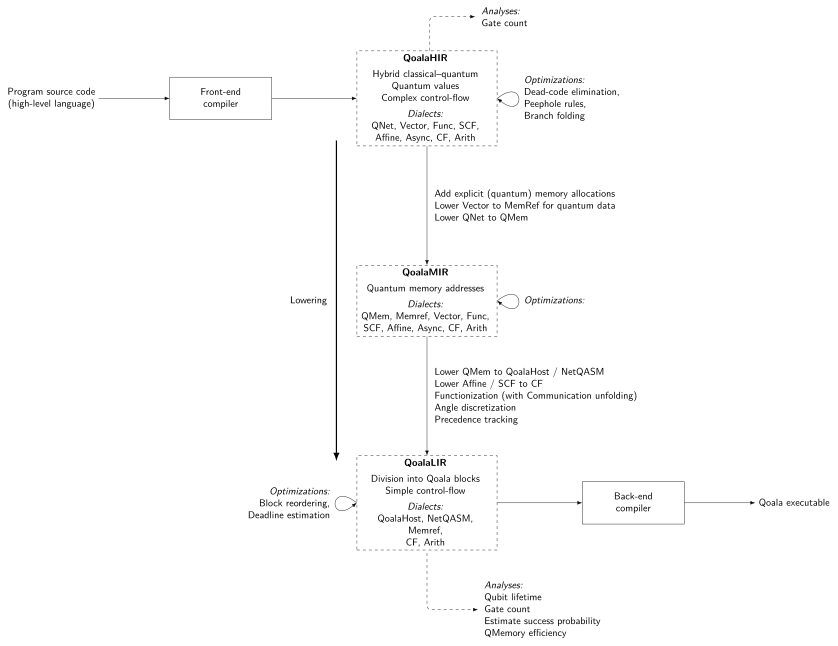
euqalyptus is the Python-based frontend that lets you write a quantum-network program as ordinary Python and produce Qoala HIR, the highest-level intermediate representation of the Qoala compiler stack.
Two ways to write a program
You can author a program in two equivalent shapes. The decorator form turns an ordinary function into a QoalaProgram:
from euqalyptus import QoalaProgram

@QoalaProgram
def my_program():
    ...
The class-based form subclasses QoalaProgramBase and implements main():
from euqalyptus import QoalaProgramBase

class MyProgram(QoalaProgramBase):
    def main(self):
        ...
Both end up as the same kind of object internally; calling .compile() on either yields a (return_value, QoalaModule) tuple, where QoalaModule.asm is the textual Qoala HIR that you would pipe into qoala-mlir. See SDK reference / Programs for the difference between the two patterns and when to pick which.
What you can express
The SDK exposes a small surface that maps directly onto the operations supported by the QNet dialect of Qoala HIR. On the classical side there are the basic numeric types — Int, Int32, UInt32, Bit, Float, Double — together with the array variants IntArray and FloatArray. These behave like normal Python values inside a @QoalaProgram body but actually emit HIR ops behind the scenes. On the quantum side, LocalQubit constructs a locally initialized qubit, EntangledQubit (or the Entangle() factory) represents the local half of an EPR pair shared with a remote node, and ScopedQubit is a recording-time proxy used when a qubit must survive a conditional branching region.
Qubits support the usual single-qubit gates (X, Y, Z, T, H, S, the rot_X/Y/Z parameterized rotations), the two-qubit gates (cnot, cz, cphase), and measurement. The Remote("Alice") constructor declares a remote node by name, after which classical and entanglement operations targeting that node refer to it by that alias. Classical communication is available as send_int, recv_int, send_float, recv_float, plus their array (send_ints, recv_ints, …) variants. Control flow is shaped by return_results(...) to terminate the program, and by the if_cond family of context managers for runtime-conditional branching. The full reference is in SDK reference.
How the frontend produces HIR
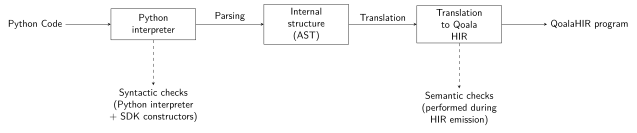
When you call .compile(), the SDK turns your Python function into a QoalaHIR module in three logical steps, all carried out inside euqalyptus/__init__.py. First, a global _compiler_lock is acquired and a fresh QoalaModule is created — this gives the SDK a single piece of state to record into while it processes your function. Second, your decorated Python function is executed: SDK constructors such as Int(10), Entangle("Alice"), and q.measure() do not perform the operation in the moment, but record AST nodes (QoalaExpression, QoalaOperation, …) into the module's current function body. Third, once the function returns, QoalaModule.generate_qoala_hir() walks the recorded AST and emits MLIR operations using the qnet Python bindings shipped by qoala-mlir.
The resulting module is reachable as module.asm (pretty-printed) or module.generic_asm (generic-form MLIR). For the deeper version of this story, see Architecture / From Python to Qoala HIR.
What happens after HIR
Once you have textual HIR, the rest of the pipeline lives in qoala-mlir:
qoala-opt program.hir.mlir \
    --qnet-peephole-optimizations \
    --qnet-dead-code-elimination \
    --lower-qoala-hir-to-mir \
    --lower-qoala-mir-to-lir \
| qoala-translate --mlir-to-iqoala > program.iqoala
See Continuing the pipeline for the full handoff.